The Southwest's Water Crisis Is Showing Up in Our Front Yards
Drive through almost any California suburb after a dry summer and you'll see it: lawns gone brown, flower beds left bare, and street trees with thinning canopies. For many homeowners, watering the yard has become something they have quietly given up on.
The water crisis across the Southwest
The American Southwest, from California across Arizona, Nevada, Utah and New Mexico, is the driest part of the country, and it is getting drier. Scientists who reconstructed the region's climate from tree rings found that 2000–2021 was its driest 22-year period in at least 800 years, a megadrought made worse by rising temperatures.
Much of California's water starts as snow in the Sierra Nevada. The Bay Area's Hetch Hetchy system, which serves 2.7 million people, gets about 85 percent of its supply from Sierra snowmelt, and in dry years there may be little runoff to capture. Southern California also leans on the Colorado River, which supplies some or all of the water for nearly 40 million people in seven states. It is stretched thin: after the states that share it failed to agree on new rules for after 2026, the federal government cut deliveries to California, Arizona and Nevada by 1.25 million acre-feet for 2027, just as Lake Mead and Lake Powell hit record lows.
Drought is the new normal
Unlike most of the country, the Southwest swings between feast and famine, and California swings hardest, with the most year-to-year rainfall variability in the continental U.S.
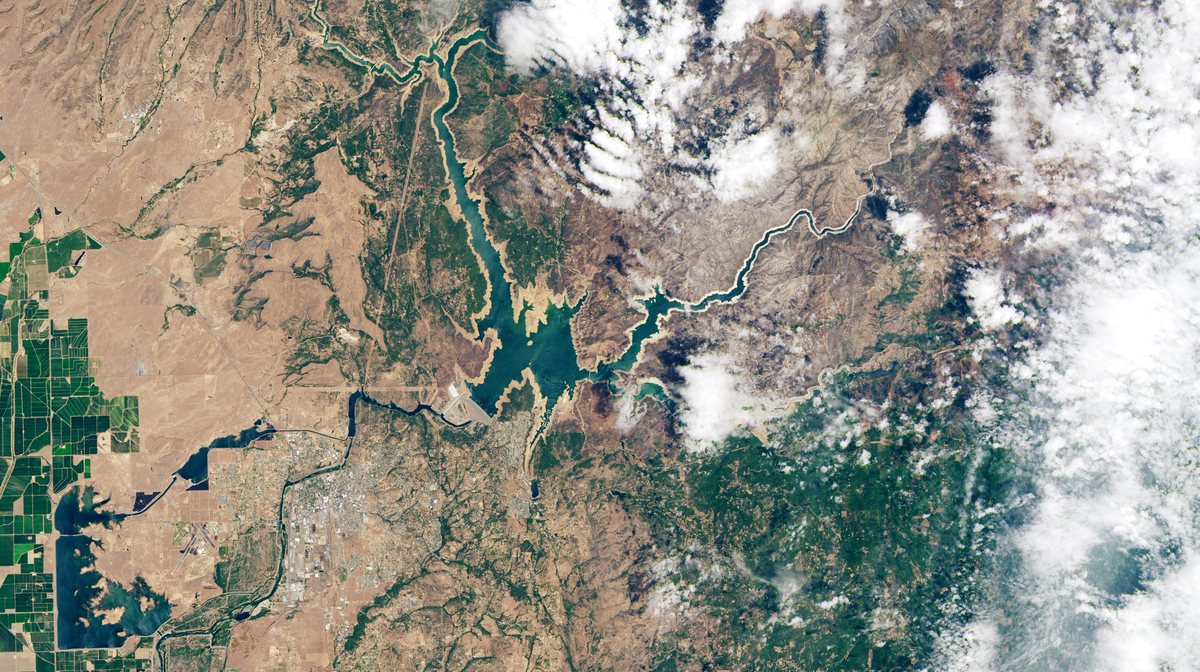
Those swings add up to long droughts. In little more than a decade, California has been through two major multi-year droughts, from 2012 to 2016 and from 2020 to 2022. The 2012–2016 drought was the most severe in the state's recorded history. Scientists who reconstructed past conditions from blue oak tree rings found that its 2012–2014 stretch was the worst in at least 1,200 years, and that record heat, more than missing rain, is what made it so extreme.
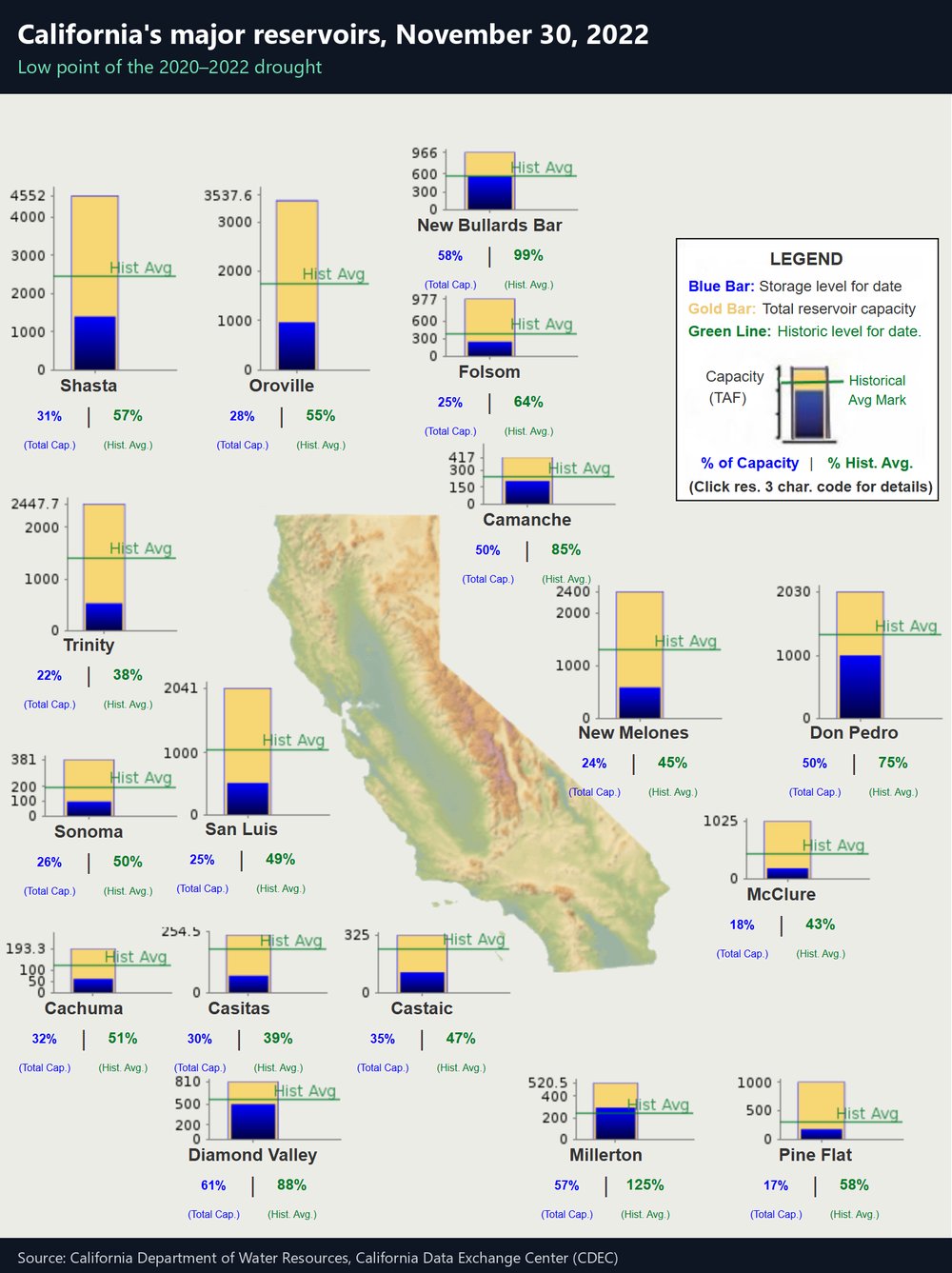
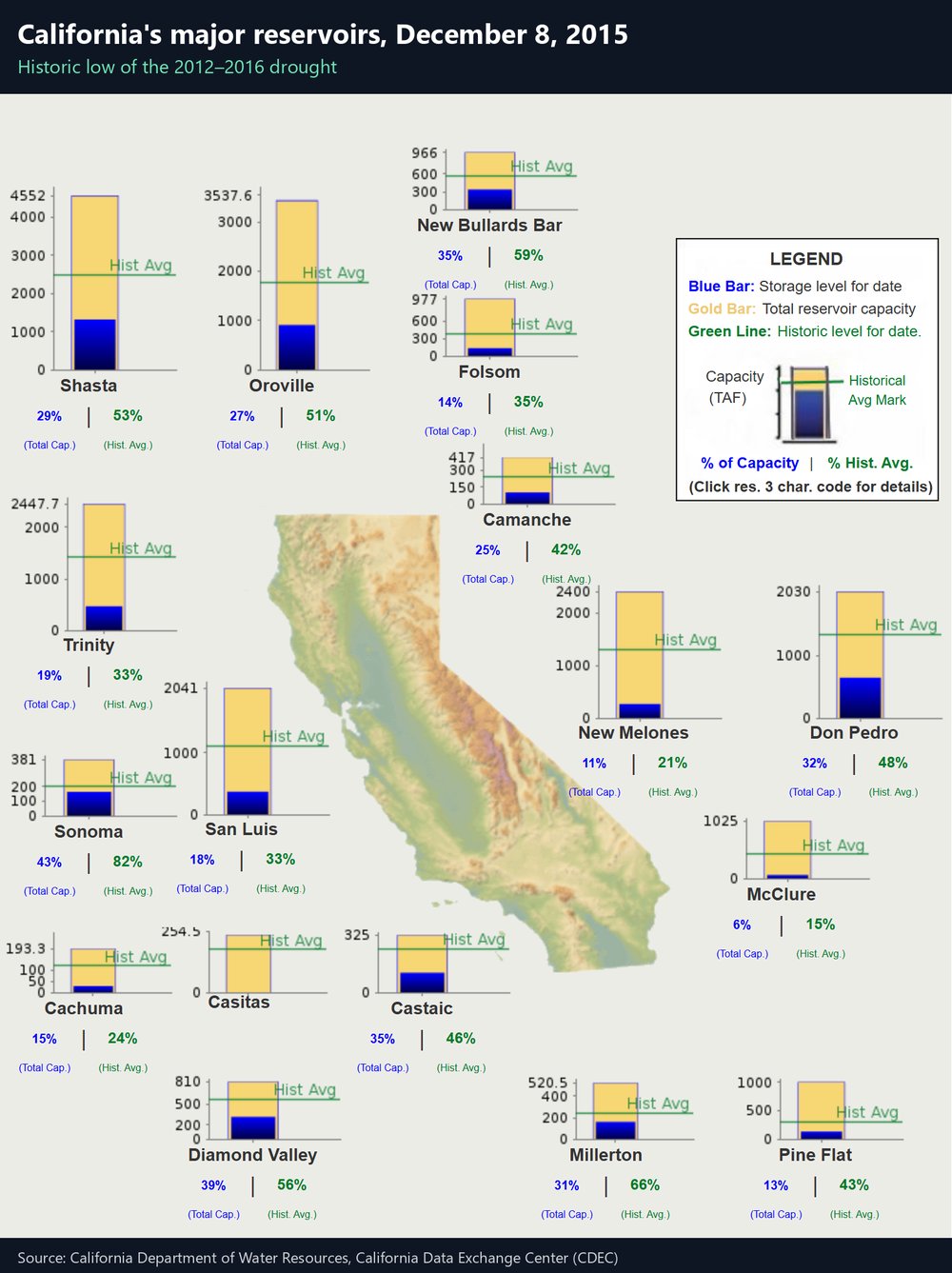
Watering restrictions have become the norm. From 2027, a new state law bars using drinking water on decorative grass at businesses. In 2022, the state banned wasteful watering such as hosing down sidewalks and driveways or watering lawns after rain, with fines of up to $500, and the Metropolitan Water District of Southern California limited outdoor watering to one day a week for millions of people. In 2015, California ordered the first mandatory statewide cut in its history, requiring cities to reduce water use by 25 percent.
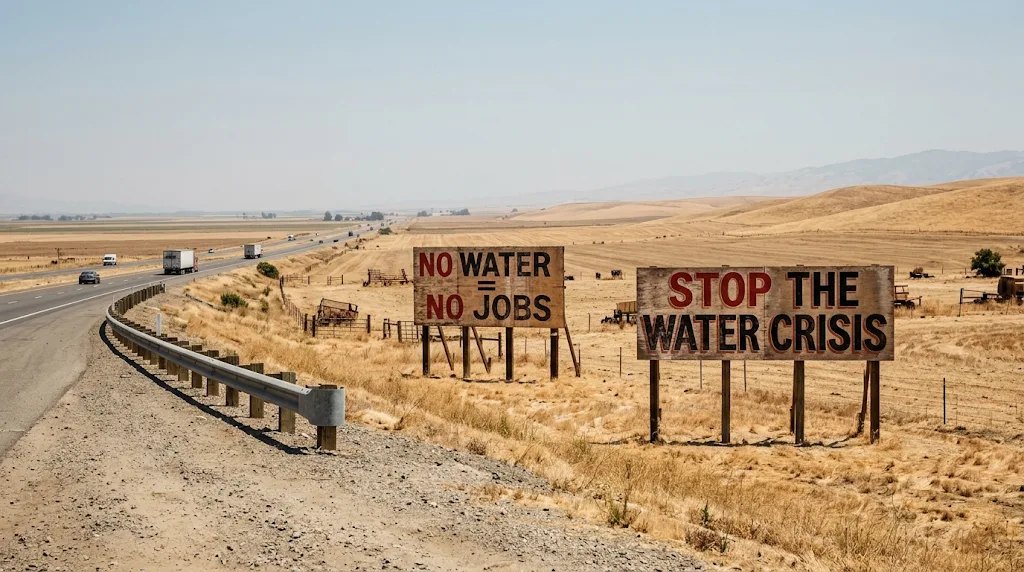
When supplies tighten, households feel it first, because urban water agencies are the ones asking customers to cut back, and outdoor watering is the obvious target. Researchers who measured Los Angeles yards found lawns were often watered well beyond what the grass needed.
A precious resource on a blue planet
We call Earth the blue planet, and for good reason: about 71 percent of its surface is covered by water. But about 96.5 percent of all that water is in the oceans, too salty to drink or to grow crops with. Of the fresh water that remains, more than two-thirds is locked up in ice and glaciers and most of the rest is underground. Only a sliver sits in the lakes and rivers we can easily reach.
That makes fresh water the most precious natural resource we have, and the strain on it is not just a California story. A landmark 2016 study in Science Advances found that about four billion people, two-thirds of the world's population, face severe water scarcity for at least one month every year.
“When the well's dry, we know the worth of water.”
The extreme cases show how far it can go. The Aral Sea in Central Asia was once the fourth-largest lake in the world. After the rivers feeding it were diverted to irrigate farmland starting in the 1960s, it shrank dramatically, and in 2014 its eastern basin dried up completely.
Water is also increasingly a source of conflict: the Pacific Institute recorded 420 water-related violent incidents worldwide in 2024. In 2021 a dispute over a water intake on the Kyrgyzstan–Tajikistan border escalated into fighting that killed more than 50 people, and in 2025 India suspended the treaty that has shared the Indus rivers with Pakistan since 1960, which Pakistan warned it would treat as an act of war.
The rising cost of watering at home
Scarcity, aging pipes and dams, and new supply projects all show up on the bill. In Silicon Valley, the wholesale charge for North County groundwater, which local water companies pass on to customers, has risen about 129 percent since 2016. In Los Angeles the residential base rate is up about 135 percent since 2015, in San Diego about 118 percent, and in Palm Springs about 60 percent since 2017.
Residential base rates (Silicon Valley: wholesale groundwater charge), in cents per gallon, not adjusted for inflation. Sources: Valley Water, LADWP, City of San Diego, Desert Water Agency.
For many families, those increases landed on top of the wider cost-of-living squeeze, when groceries, rent and energy were rising at the same time. Watering the lawn is one of the few household costs people can simply switch off.
New supplies won't bring prices down. The big options are expensive, slow, or both.
Desalination works, but it is costly. Water from San Diego's Carlsbad desalination plant cost about $3,500 per acre-foot in 2025, the region's most expensive supply and more than the Silicon Valley groundwater charge in the chart above.
“It's incredibly expensive, it's energy intensive, it has environmental liabilities.”
Piping water in from wetter regions such as the Pacific Northwest has been floated for decades, but a 2012 federal study of the Colorado River set such pipelines aside as not "cost effective or practical." Even projects within California take billions and many years: the estimated cost of the Delta Conveyance tunnel rose from $16.7 billion in 2018 to $20.1 billion in 2024.
Missing our lawns

For generations, a green yard, with its lawn, shrubs and flowers, has been part of the American dream: a natural playground where kids run, pets roll and families gather. As water got scarcer and pricier, many homeowners turned their sprinklers off, and that playground faded.
Brown lawns are only the most visible sign. Trees that relied on lawn watering decline, streets lose shade and heat up, and bare soil sheds rain instead of soaking it up.
How sprinklers waste water
Look closely at a typical neighborhood and you'll see where the water goes. The U.S. Environmental Protection Agency estimates that as much as 50 percent of the water used outdoors is lost to wind, evaporation and runoff caused by inefficient irrigation. Nationally, homes use nearly 8 billion gallons of water a day outdoors, mainly on landscapes, and the average American household uses more water outdoors than for showering and washing clothes combined.
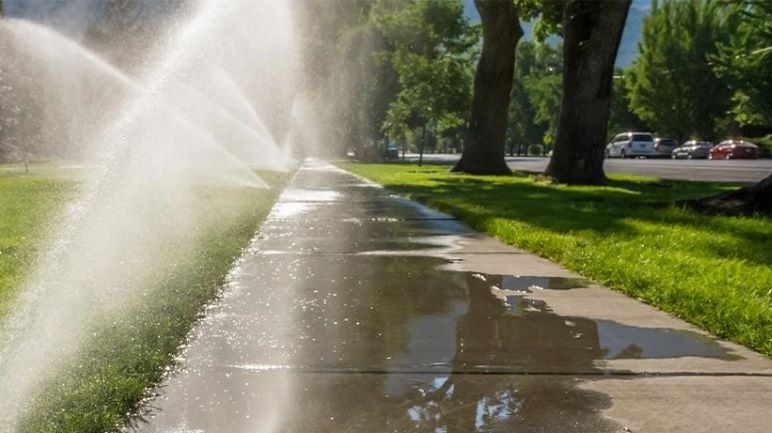
The most common ways sprinklers waste water:
- Spraying the sidewalk, driveway and street instead of the lawn
- Running so long that water runs off into the gutter
- Watering in the heat of the day or in the wind, when much of it evaporates or drifts away
- Clock timers that keep running through rain and cool weather
- Broken, tilted or clogged heads, and the same water for every part of the yard
Fixing even part of this pays off. The EPA estimates that replacing a standard clock timer with a WaterSense labeled smart controller can cut an average home's irrigation water use by 15 percent.
Precision watering is the key
The cheapest, fastest new supply is the water we stop wasting. The Pacific Institute estimates that California's cities could cut their water use by 30 to 48 percent through efficiency, including watering more precisely.
“Investing in these options is going to be cheaper and more effective and quicker than investing in the traditional things that we've done statewide in the past.”
Homeowners just need the right tools to know where water is actually needed, so they can water what matters and stop wasting the rest.
Saving water and still being able to touch grass are not opposites. The answer isn't giving up on your yard. It's watering smarter.
Sources
- Megadrought study, Nature Climate Change (2022)
- SFPUC, Hetch Hetchy supply
- U.S. Interior, Colorado River cuts (2026)
- Griffin & Anchukaitis, Geophysical Research Letters (2014)
- The Guardian, California water fines (2022)
- USGS, How much water is on Earth
- Mekonnen & Hoekstra, Science Advances (2016)
- Pacific Institute, Water Conflict Chronology
- LADWP, residential water rates
- Valley Water, groundwater charges
- City of San Diego, water rates
- KESQ, Desert Water Agency rates (2026)
- Voice of San Diego, desalination costs (2025)
- EPA WaterSense, outdoor water use
- Pacific Institute, urban water efficiency study (2022)