The Quiet Revolution in Irrigation: How Farms Learned to Do More With Less Water
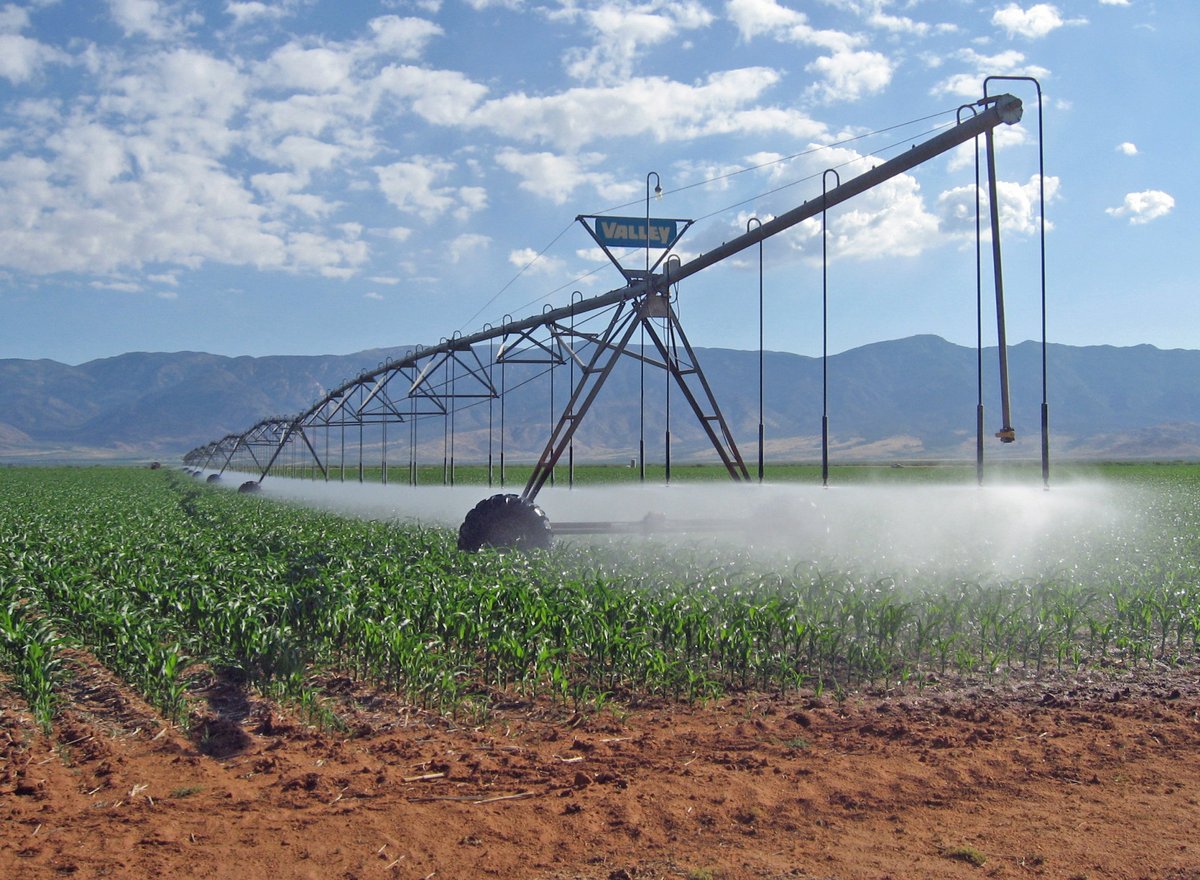
Farms are where most of the world's water goes: agriculture accounts for roughly 70 percent of fresh water withdrawn worldwide. So when water gets scarce or expensive, farmers feel it first. The last few decades have brought incredible innovation in how they water, from drip lines and upgraded sprinklers to soil sensors, weather networks and satellites, and many farms now grow more with less by watering with precision instead of by habit.
Drip: water at the roots
Flood and furrow irrigation soak whole fields, and much of that water evaporates or runs off before plants can use it. Drip irrigation, commercialized in the 1960s, delivers water slowly through tubing straight to each plant's roots. The UN Food and Agriculture Organization reports that drip systems can reach up to 95 percent efficiency and use 30 to 50 percent less water than surface irrigation.
The savings show up in field trials. In South Texas, drip-irrigated watermelons used 46 to 60 percent less water than furrow-irrigated ones, with no difference in yield.
Taming the jumbo sprinklers
Across the West, giant center-pivot machines and traveling sprinkler guns still spray water high into the air, where wind and heat carry much of it away. Many farmers are retrofitting them with drop hoses that release water just above the ground, a method known as low-energy precision application (LEPA). University of Nebraska–Lincoln Extension reports that converting low-angle impact sprinklers to LEPA can raise efficiency by 10 to 12 percent.
Watering by data, not the calendar
The science behind this goes back decades. In 1982, UC Davis and the California Department of Water Resources built CIMIS, a statewide network of weather stations that tells growers how much water their crops lose each day. In 1998, the UN Food and Agriculture Organization's Irrigation and Drainage Paper 56, by Richard Allen, Luis Pereira, Dirk Raes and Martin Smith, set the method still used worldwide to calculate how much water a crop needs.
The next step is knowing exactly when and how much to water. Soil moisture sensors measure how wet the root zone really is: in a University of Florida field study, sensor- and weather-based scheduling saved up to 30 percent of water compared with a fixed schedule, without reducing the harvest.
Satellites help too. OpenET, a project backed by NASA and partners across the West, uses satellite data to estimate how much water each field's crops actually use. Research summarized by the project found that irrigation guided by those estimates cut applied water by 15 to 27 percent, with substantial cost savings for farmers.
Less water pumped also means lower energy bills for pumping, which is why precision irrigation tends to pay for itself in dry, expensive-water regions.
What the national data shows
American farms have already changed a lot. A USDA Economic Research Service review found that across the 17 Western states, pressurized systems such as sprinklers and drip covered 72 percent of irrigated cropland in 2018, up from 37 percent in 1984, while acreage watered by flooding fell sharply. Because pressurized systems lose less water to evaporation, deep seepage and runoff, the shift has helped farms cope with scarcer supplies.
Creative ideas from US universities
Researchers are now testing bolder ideas. At UC Merced, scientists estimated in 2021 that covering California's roughly 4,000 miles of canals with solar panels could save more than 65 billion gallons of water a year by cutting evaporation. A pilot with the Turlock Irrigation District has since reported 50 to 70 percent less evaporation under the panels.
At the University of Arizona, researchers grew crops in the shade of solar panels. Jalapeños produced about the same fruit as in the open but lost 65 percent less water through their leaves, and the soil stayed about 15 percent wetter.
UC Davis is flipping the problem around: flooding farmland in winter, when water is plentiful, to refill the aquifers farms pump from in summer. In trials on almond orchards and other crops, the water table rose quickly without damaging the crops, and researchers estimate about 3.6 million acres of California farmland are well suited to it.
And the University of Nebraska–Lincoln turns irrigation into a competition. In its Testing Ag Performance Solutions program, farmers manage real research plots with the tools of their choice and compare water use, yield and profit; three in four participants reported adopting new farm technology afterward.
The expensive alternatives
Some growers try to skip outdoor irrigation altogether. Indoor vertical farms grow greens under LED lights and claim to use up to 95 percent less water than fields, but the electricity, labor and construction costs are enormous. AeroFarms, one of the best-known vertical farming companies, filed for bankruptcy in 2023.
Making new water is costly too. Desalinated seawater from San Diego's Carlsbad plant cost about $3,500 per acre-foot in 2025, the region's most expensive supply. For most farms, wasting less of the water they already have is far cheaper than finding new water.
Bringing farm-grade precision home
Our backyards are an incredible asset, and most of us use only a fraction of them. With the same precision that farms rely on, a yard can hold more green lawn, immaculate gardens and flowers, and even a kitchen garden, with vertical planters and raised beds producing organic vegetables and herbs a few steps from the kitchen.
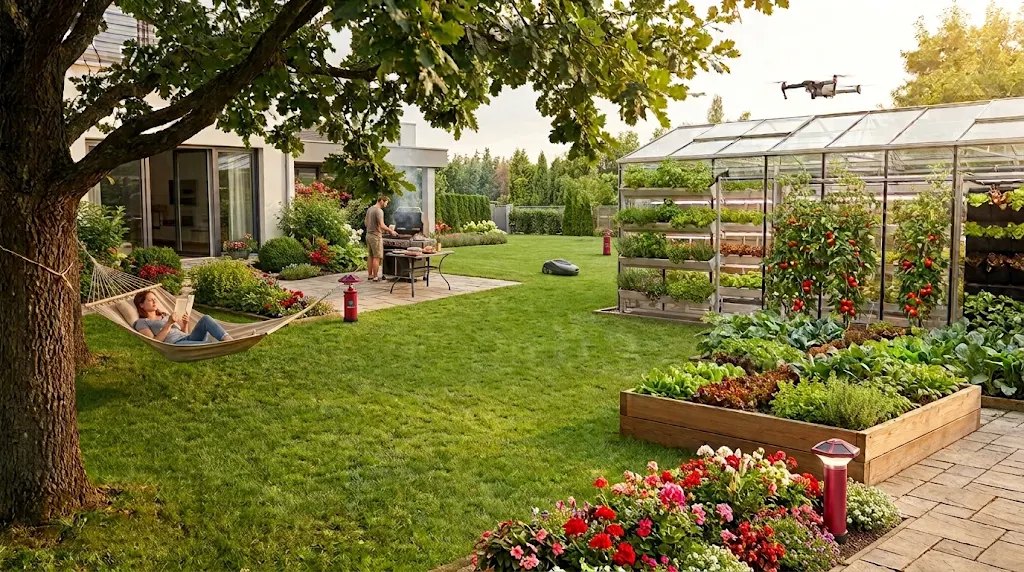
The farm techniques translate directly:
- Drip irrigation becomes precision sprinklers that put water only where plants need it.
- Evapotranspiration monitoring becomes remote sensing of each part of the yard, so watering matches what the plants actually use.
- Weather-smart watering adjusts for heat, wind and the chance of rain, and skips a cycle when a storm is on the way.
- Measuring moisture in the soil means watering exactly as much as it can absorb, with no runoff into the street.
- Reusing household water, such as laundry graywater, and using recycled non-potable water where it is available keeps drinking water for drinking.
Precision, not sacrifice, is how both farms and homes keep growing in a drier world.
Sources
- World Bank, Water in agriculture
- USDA ERS, Trends in U.S. Irrigated Agriculture (2021)
- FAO, Drip irrigation
- University of Nebraska–Lincoln Extension, center pivot efficiency (G1328)
- CIMIS, Helping Californians irrigate efficiently
- Allen, Pereira, Raes & Smith, FAO Irrigation and Drainage Paper 56 (1998)
- Farag et al., drip vs furrow watermelon, South Texas (2018)
- UF/IFAS, information-driven irrigation scheduling
- NASA, OpenET
- Canary Media, why vertical farming struggles
- Voice of San Diego, desalination costs (2025)
- USGS Water Science School, irrigation images
- TechXplore, UC Merced solar canal study (2022)
- PBS NewsHour, solar over California canals
- University of Arizona, agrivoltaics study (2019)
- UC Davis, flooding farms to replenish groundwater
- University of Nebraska–Lincoln, TAPS program